Japanese Temples
These pages are a photographic guide to Japanese Buddhist temples, Shinto shrines, gardens and castles, particularly those of historic significance in the Kyoto and Nara areas of Western Japan.
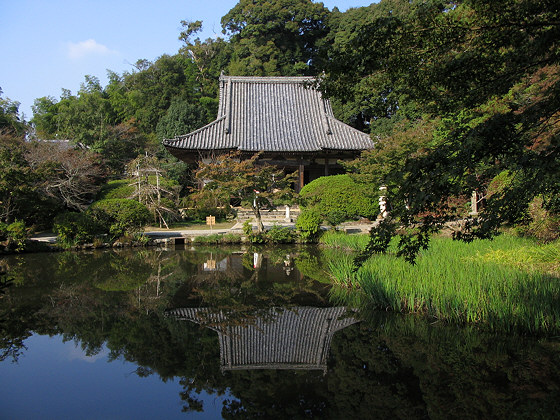
Chogakuji Temple hondo.
If you are planning a trip to Japan, visiting some of the ancient temples and their gardens is a good way to start. These pages contain photos of many of those places, and others mentioned in ancient Japanese literature.
Ancient temples and shrines by region
Kyoto City
Kyoto Prefecture
Lake Biwa
Nara City
Nara Prefecture
Kamakura
Osaka
Hyogo
Wakayama
Other
Buddhist temples
Japanese temples dating from the Nara (710-794), Heian (794-1195), Kamakura (1195-1333) and Muromachi (1333-1460) periods are often very beautiful and there is a large number of them clustered around the ancient capitals of Nara, Kyoto and Kamakura. Although most temples were destroyed in the Onin Wars (1467-1477), many have been rebuilt several times following their original design.
Temple names and buildings
Japanese temple names have the suffix "dera, ji, in", or occasionally "an". The first two indicate a main temple, with "dera" being the Japanese reading of the characters and "ji" being the original Chinese reading. The "in" suffix normally indicates a sub-temple, and "an" denotes an arbour or cottage. Gardens usually have the suffix "en". A "do" suffix, or occasionally "den," is added to the names of halls within a temple.
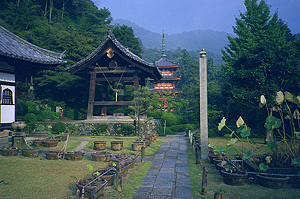
The most common hall names are Hondo, Kondo or Butsuden (Main Hall), Kodo or Daikodo (Lecture Hall), Jikido (Refectory), Amidado (Amida Hall), Mieido (Founder's Hall), Godaido (Hall of the Five Great Deities), Shinden (Imperial Residence), Kaidanindo (Ordination Platform Hall), Kannon-do (Kannon Hall), Reihokan (Treasure Hall, Museum), Priests' Quarters (Honbo, Daihojo), Shakamunido (Shaka Hall) and Haiden (Worship Hall). An Okuno-in is an inner sanctuary dedicated to a specific person, usually Kobo Daishi, Japan's great saint, or a temple's founder. Monzeki temples are those whose head priest was by tradition a member of the imperial family. They are identified by five parallel white lines on the outer wall.
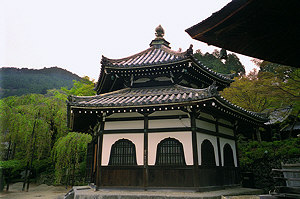
Other buildings seen on temple grounds are sutra halls (sometimes hexagonal in shape), pagodas, tahotos, bell towers (shoro) and a variety of gates.
Sects
Originally introduced from Korea in 538, Japanese Buddhism is of the
Mahayana (Greater Vehicle) tradition. The Nara period saw massive
temples built in the capital and increasing political power wielded by
priests. Six schools of Buddhism flourished at this time - Sanron,
Jojitsu, Hosso, Kusho, Ritsu and Kegon - based mostly on the study of
commentaries or treatises on particular sutras. After the capital was
moved to Kyoto in 794, only two temples were allowed in the city, Toji
and Saiji.
New forms of Buddhism were then brought back from China by
Japanese monks. Saicho founded the Tendai sect on Mount Hiei, northeast
of Kyoto, and Kukai founded the Shingon sect, initially at Toji and
later centred on Mount Koya. Tendai was based on the Lotus Sutra and
Shingon was a development of Chinese esoteric teachings. Both sects
were patronised mainly by the aristocracy. Their temples were in the
mountains and the sacred images displayed in dim halls or
hidden from view.
At the end of the Heian period in 1195, the shoguns took over and moved
the capital to Kamakura. New sects - Jodo (Pure Land) and Jodo Shin
(True Pure Land) based on devotion to Amida Buddha - brought Buddhism
and hope for rebirth in the Pure Land to the common man. These were
followed the Soto and Rinzai Zen sects focussing on mediation and koans
as the means to reach enlightenment. Because of its application in
swordsmanship and archery, Zen was patronised by the shoguns and their
samurai. The last major sect to emerge - Japan's only indigenous form
of Buddhism - was Nichiren, based on devotion to the Lotus Sutra and
popular with the common man.
Jodo temples are often large buildings situated in urban centres and
enshrining a large image of Amida. Zen temples feature a very different
architecture, fequently with numerous sub-temples and "dry gardens" of
moss or gravel. The Zen sects revere Shakyamuni (the historical
Buddha), his disciples and other famous enlightened monks.
Statuary
A wide variety of Buddhist statuary can be seen in Nara and Heian
period temples. These can be categorised as buddhas (nyorai,
enlightened beings), bodhisattvas (bosatsu, beings who have
postponed their final enlightenment to help others) and "guardians of
Buddhism" (Hindu deities imported into Buddhism). Pure Land temples
generally enshrine an image of Amida Nyorai while Zen and Nichiren
temples revere images of Shakyamuni
(Shaka Nyorai). The principal object of worship in a temple is known as
the honzon.
Among the other objects of worship in Japanese temple grounds are
bussoku, or Buddha's footprints,
engraved in stone. However, these are ususally much smaller than the
elaborately gilded footprints found in Thai temples.
Pilgrimages
Buddhist Pilgrimages played an important part in the lives of
Heian-era Japanese aristocrats and later became popular with the common
people. The most famous temple circuit - which dates from Heian times -
is the Saigoku Kannon pilgrimage
of 33 temples in Western Japan. Another well-known circuit is the
88-temple pilgrimage dedicated to Kobo Daishi (Kukai) on the island of
Shikoku. And there are many more. A more recent circuit is the Kyoto Jusan Butsu, a
pilgrimage dedicated to the 13 sacred buddhas and bodhisattvas
(butsu) of the Shingon sect. Each temple enshrines one of these
butsu.
Temple circuits are known in Japanese as junrei. Before the
first circuit was created in the Heian period a number of temples were
popular as pilgrimages in their own right. Three of them -
Kiyomizu-dera, Ishiyama-dera and Hase-dera - enshrined highly respected
images of Kannon and were favoured by aristocratic ladies of the time.
Another, forbidden to women, was the mountain-top temple complex of
sacred Mount Koya in Wakayama.
Among the most well-known pilgrimages in Western Japan are:
- Saigoku Kannon
- Saigoku Kannon (a personal account of the pilgrimage)
- Kyoto Jusan Butsu (13 buddhas)
- Nara Jusan Butsu (13 buddhas) - a personal account
- Rakuyo - Kannon pilgrimage in Kyoto
- Yakushi 49 - Yakushi pilgrimage in Western Japan
Kyoto City Temples
There is no surviving Heian-era architecture in Kyoto City as everything was razed to the ground during the Onin Wars of the 15th century. However, there are many temples and shrines of great historical interest and a number of famous Zen temples. Kiyomizudera temple is well-known as a pilgrimage destination and for the magnificent view from its large open platform. Toji temple stands out for its huge buildings and statuary, reminiscent of the Nara style.
Kyoto Prefecture Temples
Outside Kyoto City there is a number of temples and shrines in beautiful rustic settings. To the north lies Kurama and Kibune, to the northwest Kiyotaki, to the northeast Ohara, and Uji to the south. Uji's Byodo-in temple is the only surviving Heian-era temple architecture in the prefecture, and Daigoji temple's pagoda is the oldest wooden structure in Kyoto prefecture.
Shinto Shrines
Shinto is the native religion of Japan, its main practice being the worship of clan deities and local deities inhabiting mountains, rivers, and other natural features. It has no doctrine or scriptures and the most well-known shrines belong to the imperial and old aristocratic clans. Shinto shrines have the suffix "jingu, taisha" or "gu", with "jingu" indicating an imperial shrine. Typically, Shinto shrines are in a beautiful natural setting but the buildings are rarely very impressive and the grounds feature large expanses of gravel. The deity (kami) of the shrine resides in the main sanctuary known as the Shinden or Honden, but there is no image on display. Anciliary buildings are the offering hall (Haiden) and treasury (Homotsuden).
Fushimi-inari Taisha and Iwashimizu Hachiman-gu are two very picturesque shrines south of Kyoto.


